
Castlevania: Belmont’s Curse Beginner’s Guide – 18 Tips Before You Start
Starting Castlevania: Belmont’s Curse? These beginner tips cover exploration, combat, the demo, progression, movement and how to prepare for Dracula’s castle.
Part of our Castlevania: Belmont's Curse coverage
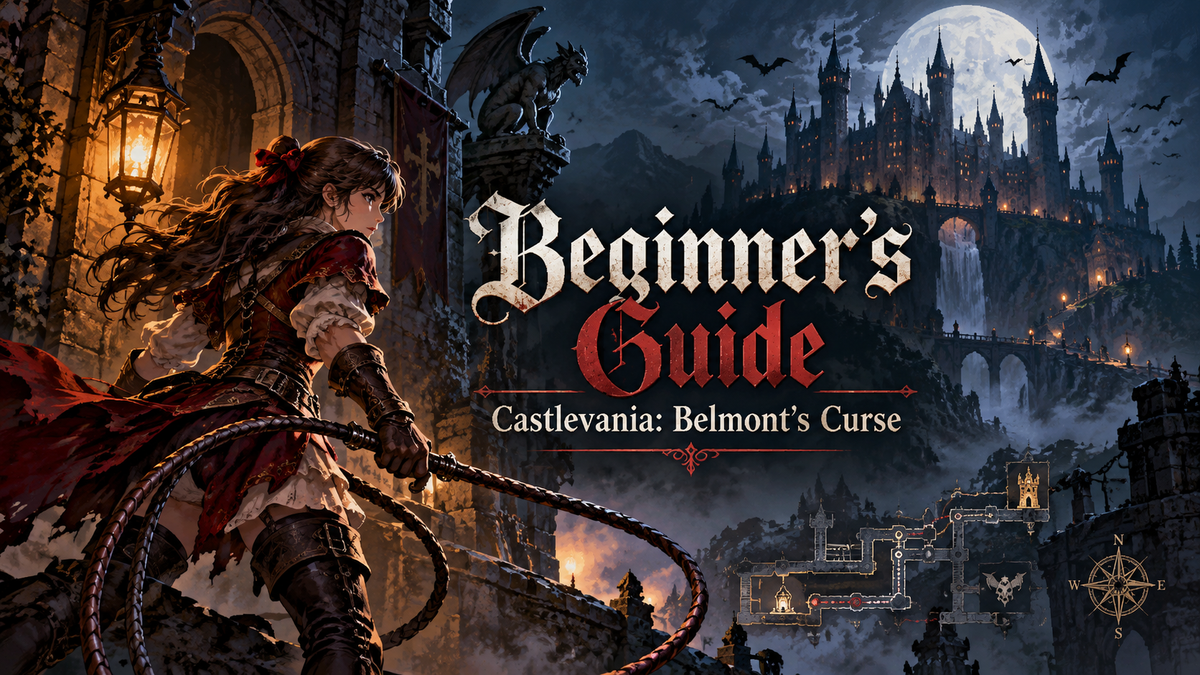
Castlevania: Belmont's Curse arrives on October 15, 2026, and it is designed as a fast-moving 2D action-exploration game rather than a simple linear platformer.
You play as Rose Belmont, daughter of Trevor Belmont, in a story set in Paris in 1499.
If you are planning to start on Xbox Series X|S or Xbox on PC, these beginner tips will help you get more from the opening hours without spoiling major story beats.
1. Play the demo first if you have not already
Konami released a playable demo ahead of launch.
The useful part is that demo progress can carry over into the full game, so there is little downside to using it as your first step.
That makes the demo more than a disposable trial. It is effectively an early start.
The official Castlevania: Belmont's Curse demo announcement confirms that progress transfers into the Day One version.
2. Treat exploration as part of progression
Belmont's Curse is built around exploration.
Do not simply follow the most obvious route and assume every side path is optional filler.
The game's structure encourages you to:
- investigate alternate routes;
- return to previously blocked areas;
- search for secrets;
- learn the shape of each area;
- and use new abilities to open routes that were inaccessible earlier.
That means route knowledge is part of your progression.
3. Learn the reach of the Vampire Killer
The Vampire Killer remains one of the defining weapons of the Belmont family.
Its range gives you an advantage over enemies that would be much more dangerous if you allowed them to close the distance.
Spend time learning exactly how far your attacks reach.
Being one step outside an enemy's threat range while still landing your own attack is often safer than rushing in.
4. Do not attack constantly
Fast combat can tempt new players into mashing attacks.
That usually works until an enemy has armour, a dangerous counterattack or a pattern that punishes overcommitting.
Learn to alternate between:
- attacking;
- repositioning;
- reading enemy movement;
- and waiting for a safe opening.
A short pause can be more useful than another hit.
5. Movement is part of combat
Belmont's Curse is designed to feel faster and more fluid than many older Castlevania games.
Use that mobility deliberately.
Movement helps you:
- escape bad positions;
- reach safer platforms;
- attack from better angles;
- avoid environmental hazards;
- and create space from aggressive enemies.
Good positioning is often more important than raw damage.
6. Learn enemy patterns before forcing damage
Strong enemies tend to become much easier once you recognise their rhythm.
On your first encounter with something dangerous, concentrate on learning:
- how attacks are telegraphed;
- where the safe zones are;
- how long recovery animations last;
- and whether the enemy reacts differently at range.
You do not need to win every new encounter quickly.
7. Use vertical space
2D action games often hide useful routes above and below the obvious path.
Look for:
- ledges;
- shafts;
- breakable-looking structures;
- moving platforms;
- and rooms with suspicious unused space.
A route that looks decorative may become important once you gain a new movement option.
8. Remember that backtracking is intentional
Returning to an older area is not necessarily wasted time.
Exploration games are often designed around the idea that a new ability changes how you read places you have already visited.
When you gain something that improves movement, combat or environmental interaction, think back to areas that previously looked inaccessible.
9. Check every new ability for non-combat uses
A new skill may appear to be designed for fighting enemies but also interact with traversal or puzzles.
Whenever you unlock something new, test it against:
- obstacles;
- suspicious walls;
- environmental objects;
- alternate paths;
- and unreachable platforms.
This is one of the easiest ways to uncover hidden content naturally.
10. Do not assume every fight must be taken immediately
If an enemy is clearly stronger than the surrounding encounters, there may be value in leaving and returning later.
Exploration-based progression means your character becomes more capable over time.
There is no prize for turning a difficult optional encounter into a twenty-minute wall.
11. Keep track of unfinished routes
You do not need to memorise the entire map.
You do need to remember when an area contains:
- a door you cannot open;
- a ledge you cannot reach;
- an unusual mechanism;
- or an obvious path blocked by a missing ability.
Those are the places worth revisiting.
12. Use healing and recovery resources before desperation sets in
New players often hold onto useful resources because they are afraid of wasting them.
Then they die with everything still available.
If the game gives you a reliable way to recover during a difficult section, use it before you are one mistake away from defeat.
13. Bosses are pattern tests
Bosses may initially look chaotic, but most difficult encounters become manageable once you stop treating them as damage races.
Break the fight down.
Learn:
- the opening pattern;
- the safest response;
- the punish window;
- the transition into the next phase.
Once you recognise the sequence, the encounter becomes much more predictable.
14. The Alucard-style bonus is cosmetic, not essential
Konami lists an Alucard-style costume as an early purchase/pre-order bonus.
Do not worry that you are missing a gameplay-critical item if you buy the standard version later.
The important thing is the game itself, not a cosmetic incentive.
15. Xbox Play Anywhere is supported
Belmont's Curse supports Xbox Play Anywhere.
That matters if you split your time between Xbox Series X|S and Xbox on PC.
Using the same Xbox account makes it much easier to keep your playtime within the same ecosystem rather than maintaining separate purchases and progress.
16. Do not rush the opening area
The first section is usually where an exploration game teaches you how it wants to be played.
Instead of trying to reach the next boss as quickly as possible, use the early areas to learn:
- attack timing;
- movement;
- enemy tells;
- the map structure;
- and how secrets are signposted.
That knowledge pays off later.
17. New Castlevania players do not need to know every old game
Belmont's Curse takes place 23 years after Castlevania III: Dracula's Curse, but that does not mean newcomers need to play decades of previous releases first.
The new game centres on Rose Belmont and is designed to tell its own story within the larger Castlevania timeline.
Knowing who Trevor Belmont is adds context, but it should not be treated as homework.
18. Explore first, optimise later
Do not turn your opening hours into a search for the mathematically perfect route or build.
The first playthrough is where the game's world, movement and enemy design are most interesting.
Experiment.
Try different approaches.
Take side routes.
Return to areas that caught your attention.
Once you understand how the systems work, optimisation becomes much more useful.
Castlevania: Belmont's Curse beginner tips – quick recap
Before starting, remember:
- play the demo if you want an early start;
- demo progress carries into the full game;
- explore beyond the obvious route;
- learn enemy patterns before forcing damage;
- use movement and range deliberately;
- revisit old areas after gaining new abilities;
- treat bosses as pattern-learning exercises;
- and do not worry if you are new to Castlevania.
Castlevania: Belmont's Curse launches October 15, 2026 on Xbox Series X|S and Xbox on PC, with Xbox Play Anywhere support.